Asset Allocation: The Investment Decision That Matters Most Has Nothing To Do With Picking Funds
Published by Anand Rathi Wealth Limited (ARWL) | NSE500-Listed Wealth Firm | Est. 2002
Association of Mutual Funds in India (AMFI) - Registered Mutual Fund Distributor | ARN: 111569
Published: July 1, 2026
Most investment conversations begin with a specific product: a fund that topped the recent performance charts, a sector dominating the headlines, or a stock recommended within private networks. While this instinct is understandable, it places the smallest operational choice first and the most consequential structural choice last.
Data-backed wealth creation demonstrates that the decision doing the heavy lifting in shaping long-term outcomes is not specific fund selection. Rather, it is how capital is systematically divided across equity, fixed income, and alternative asset classes. This is the foundation of asset allocation—an objective-driven process that deserves the rigorous focus usually scattered across short-term market noise.
Defining the Framework: Asset Allocation vs. Diversification
To establish clarity over noise, it helps to separate two concepts that are routinely conflated in mainstream market discussions:
- Asset Allocation: This answers the fundamental macro question of how much to invest across broad asset classes, such as equity, debt, and gold. It establishes the primary risk-and-return baseline for your entire capital base.
- Diversification: This addresses the micro question of where to distribute capital within those broad asset classes. For example, it dictates how the equity portion is spread across large-cap, mid-cap, small-cap allocations, and different manufacturing or defensive sectors.
The Core Rule: Allocation sets the structural architecture; diversification fills it in. While both are critical to portfolio health, asset allocation takes absolute priority because it determines the performance trajectory of everything that follows.
What the Numbers Reveal: The Mathematics of Compounding
Allocation carries significant weight because it governs a portfolio's systematic exposure to risk and return profiles, compounding quietly over multi-year horizons. To evaluate the impact of this structure, consider an identical baseline capital of ₹50 lakh deployed over a 15-year period, assuming a long-term equity baseline of 14% and a fixed-income baseline of 6.5%.
15-Year Capital Growth Matrix by Allocation Split
| Capital Allocation Strategy (Equity : Debt Split) | Effective Portfolio Return | Final Portfolio Value (15 Years) | Structural Outcome Description |
|---|
| 100:0 Allocation | 14.00% p.a. | ~₹3.57 Crore | Maximum Growth Exposure |
| 80:20 Allocation | 12.50% p.a. | ~₹2.93 Crore | Growth-Tilt with Liquidity Cushion |
| 70:30 Allocation | 11.75% p.a. | ~₹2.65 Crore | Balanced Accumulation Structure |
| 50:50 Allocation | 10.25% p.a. | ~₹2.16 Crore | Conservative Preservation Mix |
Source: ACE MF
The initial capital remains identical in every scenario. The single shifting variable is the asset allocation strategy. This uncomplicated mathematical reality accounts for a final variance of over ₹1.4 crore, proving that structural design drives long-term wealth outcomes.
Matching the Structural Mix to Explicit Wealth Goals
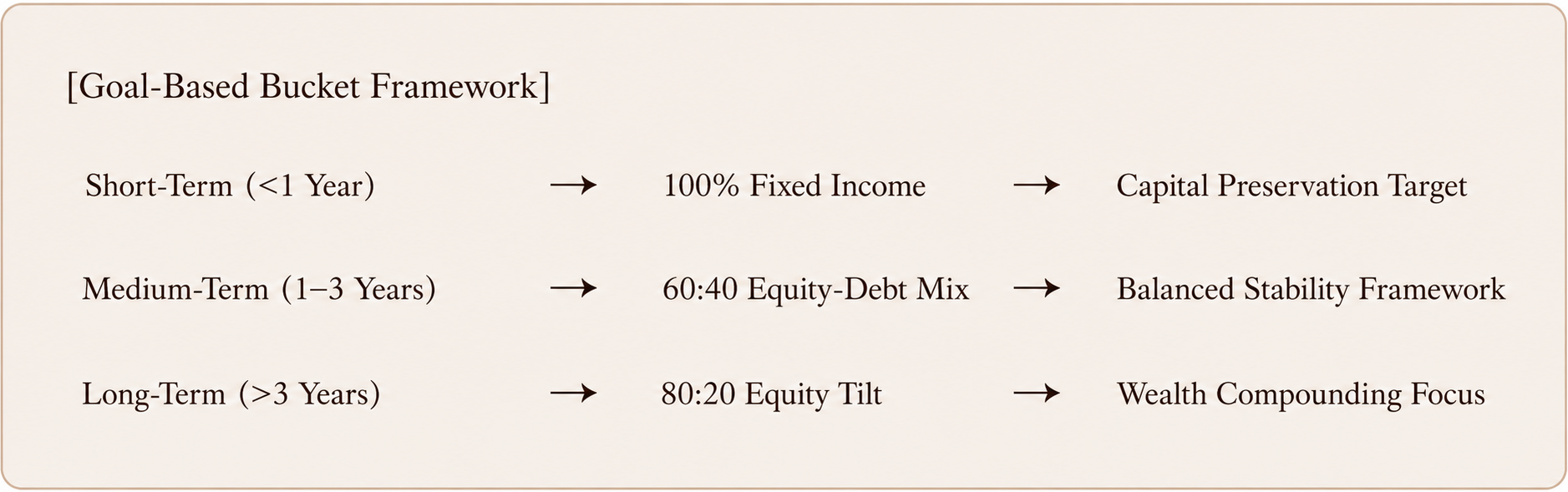
This performance gap highlights the importance of managing allocation with care. It does not mean investors should simply default to maximizing equity at all times. Instead, the right mix is the one that directly matches an investor's specific wealth goals and time horizons.
When structuring these allocations, high-net-worth investors must evaluate two distinct components: risk capacity (the mathematical ability of a balance sheet to sustain drawdowns) and risk tolerance (the behavioral willingness of the investor to weather volatility). Neither metric is determined by age alone.
A 60-year-old investor with a ₹10 crore corpus may still maintain a long-term goal, such as wealth transmission to the next generation, justifying a meaningful equity allocation. Simultaneously, that same investor may hold a short-term liquidity goal where capital preservation is the highest priority. A single wealth profile can comfortably support multiple goals, each with its own customized allocation strategy.
Evaluating Execution Pathways: Multi-Asset Funds vs. Portfolio Customization
A common validation question is whether to hand this allocation task to a single packaged multi-asset fund or maintain an independent, portfolio-led strategy. While a single fund offers operational convenience, historical performance over longer investment horizons reveals a distinct edge for customized portfolio strategies.
Extended Horizon Performance Tracking (Self-Built vs. Packaged Fund)
| Performance Evaluation Window | Packaged Multi-Asset Allocation Funds (Category Average) | Self-Built Structured Portfolio Strategy (Custom Equity Basket) |
|---|
| 1-Year Trailing Window | 11.10% | 2.01% |
| 3-Year Compounded Horizon | 16.18% | 16.26% |
| 5-Year Compounded Horizon | 13.86% | 16.15% |
Source: ACE MF
Risk Capacity vs. Risk Tolerance
To execute this effectively, investors must distinguish between two vital terms:
- Risk Capacity: The structural and financial ability of your balance sheet to absorb market volatility based on investment timelines and liquidity requirements.
- Risk Tolerance: The psychological willingness or emotional comfort of an investor while navigating market cycles.
Neither element is dictated by age alone. For instance, an Ultra-High-Net-Worth Individual (UHNI) at age 60 with a corpus of ₹10 crore may hold a multi-generational legacy goal. This long-term horizon justifies a meaningful equity allocation.
Concurrently, the same individual may also have near-term capital requirements that demand a 100% debt allocation. Under an objective-driven framework, one comprehensive portfolio can support multiple financial goals, each carrying its own tailored asset allocation.
Evaluating Execution: Custom-Built Portfolios vs. Bundled Funds
A frequent question raised by high-net-worth investors is whether to outsource this structural mix to a single packaged multi-asset allocation fund. While convenience is appealing, long-term performance data reveals distinct trade-offs.
A comparative analysis evaluated a packaged multi-asset allocation fund against a self-constructed, portfolio-led approach utilizing an 80:20 equity-to-debt allocation, with the equity component strategically diversified across Flexi Cap, Large & Mid-Cap, Mid-Cap, and Small-Cap funds.
Performance Comparison: Packaged Funds vs. Portfolio-Led Approach
| Investment Approach | 1-Year Return | 3-Year Annualized Return | 5-Year Annualized Return |
|---|
| Packaged Multi-Asset Allocation Funds | 11.10% | 16.38% | 13.86% |
| Portfolio-Led Approach (Self-Built 80:20) | 2.01% | 16.26% | 16.15% |
Source: ACE MF
The Case for Control and Granular Customization
While packaged funds can offer short-term simplicity or capture specific one-year market cycles, the case for building a structured portfolio extends far beyond a few basis points of performance.
- Targeted Risk Realization: A portfolio-led approach keeps asset allocation decisions firmly in your hands. This enables equity, debt, and gold allocations to be calibrated precisely according to your individual risk profile and evolving financial goals, rather than following a predefined fund mandate.
- Granular Diversification Control: Investors can precisely fine-tune underlying allocations—for example, 55% Large Cap, 23% Mid Cap, and 22% Small Cap. Achieving this level of customization is difficult within a single bundled fund where allocation changes occur internally without the investor's direct oversight.
Allocation Shifts as Life Milestones Evolve
Asset allocation is never a static, one-time decision. It should evolve continuously as life stages and family objectives change.
- Early Wealth Accumulation Phase: Focus on maximizing long-term compounding by using time as the primary advantage for absorbing market volatility.
- Peak Earning & Consolidation Phase: Financial aspirations become more specific, such as international education, real estate purchases, or business expansion. Each goal requires its own investment timeline and customized allocation.
- Transition & Regular Income Phase: As retirement approaches, the emphasis gradually shifts from wealth creation to capital preservation and systematic income generation.
During the distribution phase, a disciplined asset allocation allows long-term capital to remain invested in growth-oriented equity assets, while a dedicated low-volatility debt allocation provides predictable monthly cash flows through a Systematic Withdrawal Plan (SWP). This structure helps meet lifestyle expenses without prematurely depleting the primary wealth-generating portfolio.
The Bottom Line
Asset allocation rarely becomes a headline or an exciting market trend. It is not driven by speculative opportunities or attempts to predict short-term market movements.
Instead, it represents the disciplined investment principle of deciding exactly how much capital belongs in each asset class, maintaining that allocation through systematic rebalancing, and adjusting the structure only as your financial goals evolve.
While it attracts little public attention, asset allocation plays one of the most significant roles in determining long-term financial outcomes and sustainable wealth creation.
About Anand Rathi Wealth
This article is published by
Anand Rathi Wealth Limited (ARWL), an NSE500-listed wealth firm established in 2002. ARWL works with 13,941 client families across India and abroad, managing assets of ₹1,06,300 crores across 18+ cities in India, alongside a dedicated international presence in Dubai and
the UK..
ARWL operates as a CFO for personal wealth, bringing objective-driven portfolio construction, an uncomplicated process, and a long-term perspective that prioritises consistency of outcomes over short-term performance.
Our Approach to Investment Insights
At Anand Rathi Wealth, every insight is grounded in data, structured around a clear investment objective, and designed to be understood without jargon. The goal is not to impress—it is to inform.
The insights in this article are designed to encourage evaluation of consistency over isolated returns, highlight the value of structured portfolio frameworks, and support informed decision-making.
This article has been reviewed for factual accuracy by Anand Rathi Wealth Limited's insights function. This content is for informational and educational purposes only. It is designed to help readers make informed financial decisions.
FAQs
Historical performance data demonstrates that over 90% of the variance in a portfolio's long-term returns is driven by its macro asset allocation (the split between equity, debt, and alternative assets) rather than the individual funds selected. A portfolio with an incorrect asset mix will fail to meet its milestones even if you choose highly rated funds. Focusing on asset allocation ensures your portfolio matches your structural timeline and capital requirements, sheltering your wealth from the risk of selecting past winners that may underperform in the next market cycle.