SWP for Retirement: How a ₹5 Crore Corpus Can Create Regular Income
Published by Anand Rathi Wealth Limited (ARWL) | NSE500-Listed Wealth Firm | Est. 2002
Association of Mutual Funds in India (AMFI) - Registered Mutual Fund Distributor | ARN: 111569
Published: July 1, 2026
For most investors, retirement planning begins with a single goal: building a corpus large enough to support life once active income stops.
But accumulation is only half the journey. The harder, and often overlooked, phase is what follows: how do you turn that corpus into a steady, reliable cash flow, while ensuring it continues to support your family's lifestyle for years to come?
This is where a Systematic Withdrawal Plan (SWP), commonly known as an SWP, becomes an important part of the conversation.
Article Summary & Core Answer
How can a high-net-worth investor efficiently convert an accumulated nest egg into reliable monthly cash flows?
Transitioning from accumulation to distribution requires replacing active savings with a structured Systematic Withdrawal Plan (SWP) paired with a disciplined two-basket asset model.
For an investor with a ₹5 crore capital base, this approach can reliably unlock a steady cash flow of ₹1.67 lakh to ₹2.50 lakh per month while keeping the core growth engine insulated from short-term market cycles and sequence-of-returns risk.
What Is an SWP?
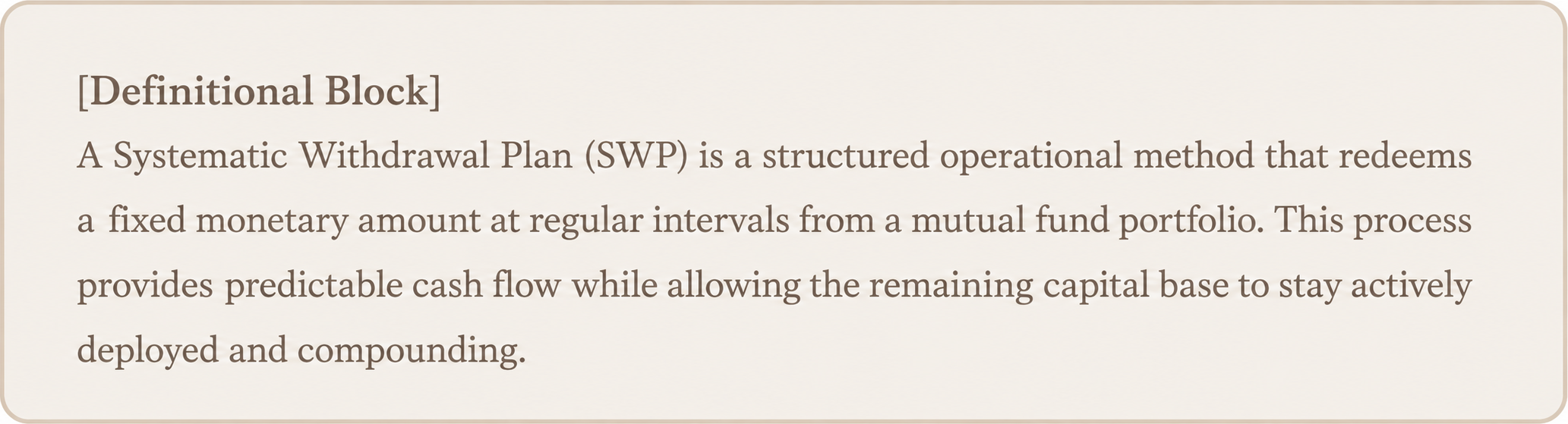
A Systematic Withdrawal Plan (SWP) allows you to withdraw a fixed amount at regular intervals from your mutual fund allocations.
In many ways, it is the mirror image of a Systematic Investment Plan (SIP). Where a SIP helps you accumulate capital systematically over time, an SWP helps you draw down systematically. For those approaching retirement, this structure can convert accumulated investments into a predictable cash flow stream, without disrupting the compounding potential of the entire corpus at once.
Understanding the 4% Rule
A widely discussed framework for retirement income is the 4% Rule. Under this approach, an investor withdraws 4% of their total corpus each year to generate income.
The principle draws on historical observation: a measured withdrawal rate of this kind may help a corpus last over an extended retirement, while the portion that stays invested continues to grow.
Consider this baseline illustration:
| Parameter | Details |
|---|
| Retirement Corpus Baseline | ₹1 crore |
| Annual Capital Extraction (4%) | ₹4 lakh |
| Monthly Cash Flow Realization | Approx. ₹33,333 |
The logic is straightforward. Rather than drawing down large sums, only a small share is withdrawn each year, allowing the remaining corpus to keep working.
A Structured Portfolio Illustration
To see how these principles function within a disciplined process, consider an investor profile moving toward their core wealth goals:
| Particulars | Details |
|---|
| Age | 53 Years |
| Current Portfolio Value | ₹90 lakh |
| Monthly SIP | ₹80,000 |
| Investment Horizon | 7 Years |
| Retirement Year | 2033 |
| Target Corpus | ₹5 crore |
| Current Asset Allocation | 100% Equity |
Having invested since 2016 and gradually increased contributions over time, this investor now seeks to build a retirement corpus of ₹5 crore by 2033.
Rethinking Asset Allocation
The portfolio today is positioned entirely in equity. For long-term milestones, balancing growth potential with liquidity requirements demands a structured approach.
Based on market data, transitioning toward a blend of 80% equity and 20% debt can help navigate market cycles. The equity portion offers the opportunity for long-term wealth preservation, while the debt allocation serves as a dedicated liquidity bucket for near-term requirements and cash flow without selling growth assets during temporary market corrections.
Will the Current Plan Meet the Goal?
Continuing with the existing investment pattern, the illustration suggests, may not be sufficient to achieve the desired retirement corpus.
| Particulars | Current Investment Framework |
|---|
| Portfolio Value | ₹90 Lakh |
| Monthly SIP | ₹80,000 |
| Investment Horizon | 7 Years |
| Annual Step-Up | 0% |
| Expected Long-Term Return | 13% |
| Estimated Final Corpus | ₹3.18 Crore |
While the corpus grows meaningfully to ₹3.18 crore, it remains below the target of ₹5 crore. With only 7 years remaining until retirement, the effect of compounding is more limited than it would be for an investor with a much longer time horizon.
Bridging the Gap: The Step-Up Approach
To move closer to the ₹5 crore target, the illustration points to two levers: investing more and adopting a disciplined annual step-up approach.
| Particulars | Current Investment | Optimized Investment Framework |
|---|
| Portfolio Value | ₹90 Lakh | ₹90 Lakh |
| Monthly SIP | ₹80,000 | ₹1,20,000 |
| Investment Horizon | 7 Years | 7 Years |
| Annual Step-Up | 0% | 23% |
| Expected Equity Return | 13% | 13% |
| Estimated Final Corpus | ₹3.18 Crore | ₹5.05 Crore |
The takeaway is a key retirement planning principle: as retirement approaches, increasing your contributions via a systematic step-up can become just as vital as the asset returns you earn.
Creating Sustainable Income From a ₹5 Crore Corpus
Once you achieve your wealth goals, the structural focus shifts from accumulation to systematic distribution. A capital base of ₹5 crore can potentially generate:
- ₹1.67 lakh per month at a measured 4% extraction rate.
- ₹2.50 lakh per month at a moderate 6% extraction rate.
This offers an uncomplicated framework for drawing regular cash flows while keeping a significant portion of the primary wealth engine fully operational.
Why the Timing of Returns Matters
There is a subtler risk in retirement that does not show up during the accumulation years: the order in which returns arrive. While you are still investing, a market downturn can even work in your favour, allowing you to accumulate more units at lower prices.
Once you begin withdrawing, the dynamic reverses. If a significant market decline arrives early in retirement, just as you start drawing an income, you are forced to sell more units to meet the same withdrawal, leaving fewer units behind to recover when markets eventually turn.
Two retirees can earn the same average return over their retirement and yet end up in very different positions, simply because of when the weak years happened to fall. This is known as sequence-of-returns risk, and it is precisely why a thoughtful withdrawal structure matters as much as the size of the corpus itself.
Drawing income from a stable liquidity bucket during volatile periods, rather than selling growth assets at depressed prices, gives the rest of the portfolio the time it needs to recover and continue compounding.
A Bucket-Based Approach to SWP
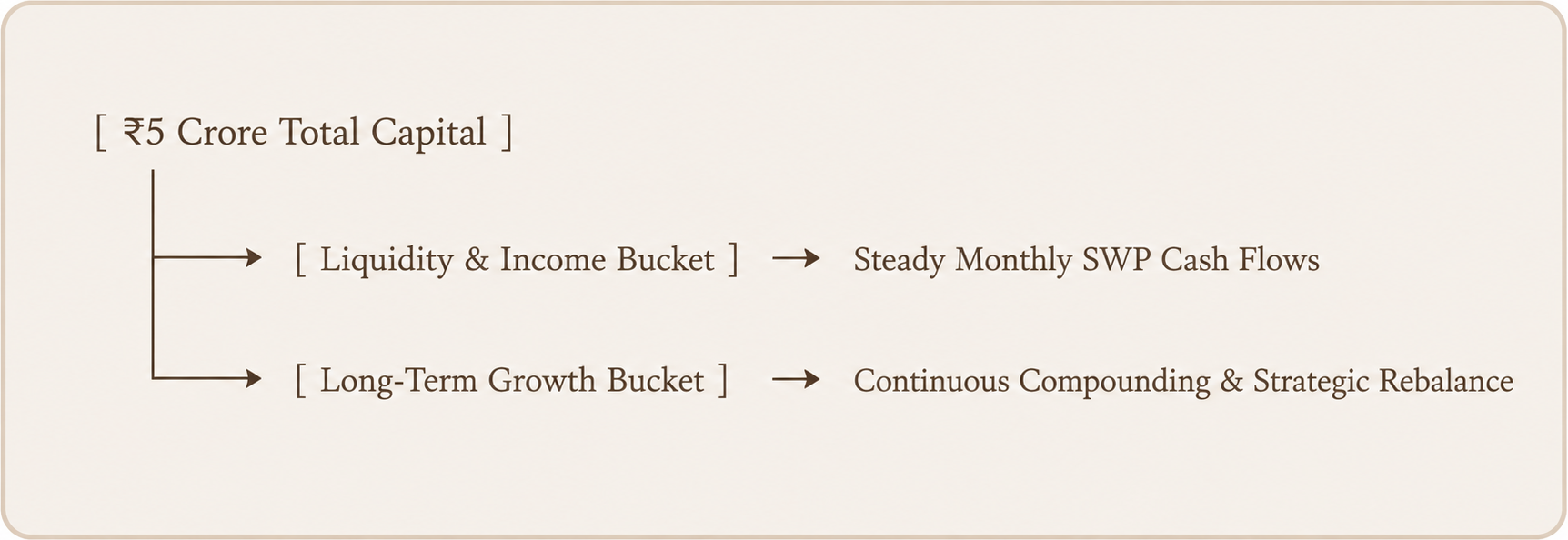
A practical way to structure retirement income is to divide investments into two separate buckets.
The Liquidity & Income Bucket: Designed to meet regular income requirements and short-term liquidity needs through low-volatility fixed-income instruments.
The Long-Term Growth Bucket: Composed of diversified equities positioned for uninterrupted compounding over a multi-decade investment horizon.
Gradually, a portion of the long-term growth bucket is shifted into the liquidity bucket through disciplined rebalancing. This keeps cash flows steady, shields your monthly income from equity market volatility, and helps ensure you never become a forced seller during market corrections.
The Bottom Line
Retirement planning is not only about reaching a target corpus. It is equally about creating a sustainable income stream from that corpus.
A structured approach that combines disciplined investing, thoughtful asset allocation, and a well-designed Systematic Withdrawal Plan (SWP) strategy can help you transition from wealth creation to retirement income with greater confidence.
The objective is not merely to build wealth, but to ensure that wealth continues to support your financial goals throughout retirement.
About Anand Rathi Wealth
This article is published by
Anand Rathi Wealth Limited (ARWL), an NSE500-listed wealth firm established in 2002. ARWL works with 13,941 client families across India and abroad, managing assets of 1,06,300 crores across 18+ cities in India, alongside a dedicated international presence in Dubai and
the UK.ARWL operates as a CFO for personal wealth, bringing objective-driven portfolio construction, an uncomplicated process, and a long-term perspective that prioritises consistency of outcomes over short-term performance.
Our Approach to Investment Insights
At Anand Rathi Wealth, every insight is grounded in data, structured around a clear investment objective, and designed to be understood without jargon. The goal is not to impress—it is to inform.
The insights in this article are designed to encourage evaluation of consistency over isolated returns, highlight the value of structured portfolio frameworks, and support informed decision-making.
This article has been reviewed for factual accuracy by Anand Rathi Wealth Limited's insights function. This content is for informational and educational purposes only. It is designed to help readers make informed financial decisions.
FAQs
An SWP from a well-allocated mutual fund portfolio offers significant advantages over traditional FDs, primarily regarding tax efficiency and inflation protection. While FD interest is taxed fully at your slab rate (up to 30% or higher for HNIs), withdrawals from an SWP are subject to Capital Gains Tax. Only the capital gains component of the withdrawal is taxed not the principal. Furthermore, keeping a portion of the corpus in equity allows your capital to continue compounding, protecting your purchasing power against inflation, which standard FDs fail to do.