Life Cycle Funds vs Building Your Own Portfolio: Which Approach Offers Greater Control?
Published by Anand Rathi Wealth Limited (ARWL) | NSE500-Listed Wealth Firm | Est. 2002
Association of Mutual Funds in India (AMFI) - Registered Mutual Fund Distributor | ARN: 111569
Published: October 8, 2026
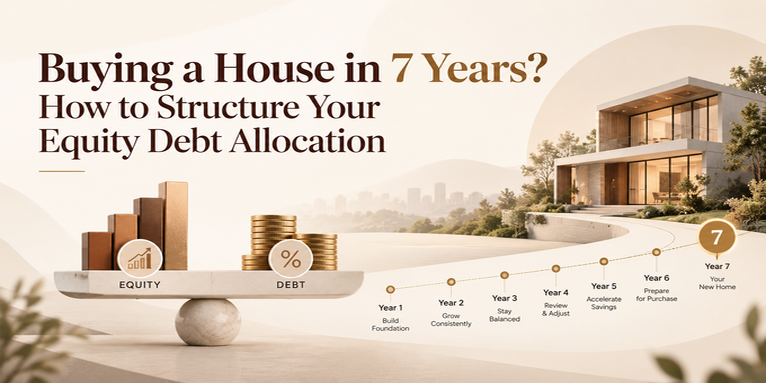
Asset allocation is not a static decision. The appropriate mix of equity and debt should evolve as the time available to achieve a financial objective reduces. Life cycle funds seek to automate this transition through a predefined glide path. Equity exposure gradually reduces and debt exposure increases as the target date approaches.
An alternative approach is to construct separate portfolios for long term, medium term and short-term goals, allowing the allocation to change as each objective moves closer. The choice between the two therefore goes beyond convenience. It also reflects how much flexibility and control an investor wants to retain over the way capital is allocated over time.
How Does a Life Cycle Fund Work?
A life cycle fund follows a predetermined allocation framework based on the number of years remaining before the target date.
When the investment horizon is long, equity can form a larger part of the portfolio. As the target date moves closer, equity exposure is progressively reduced, and the portfolio shifts towards debt.
An allocation of up to 10% can also be held in gold or silver ETFs through the investment journey.
The underlying principle is to progressively reduce dependence on equity as the point at which capital will be required comes closer.
Life Cycle Funds Are Still a New Category in India
Life cycle funds were introduced by SEBI in February 2026 and remain at an early stage of development in India.
The options currently highlighted include Zerodha Life Cycle Funds targeting 2031, 2036 and 2041, broadly corresponding to five-, ten- and fifteen-year horizons. ICICI Prudential has also launched funds targeting 2031, 2036 and 2041, while Mirae Asset has introduced a 2056 fund for investors with a 30-year horizon.
SEBI permits life cycle funds across tenures of 5, 10, 15, 20, 25 and 30 years. This creates scope for the category to broaden as more fund houses introduce products across these horizons.
The Alternative: Building Portfolios Around Financial Goals
Life cycle funds can appeal to investors who prefer a relatively hands off structure. However, investors can also construct portfolios around different time horizons and retain greater control over asset allocation.
The framework separates goals into three distinct baskets:
The significance of this approach lies in its flexibility. Financial goals are not always fixed over long periods. Priorities can shift, timelines may change and the requirement for capital can move forward or further away.
When investors construct their own portfolios, the allocation can be revisited to reflect those changes. A life cycle fund, by contrast, continues to follow the allocation path embedded within the fund structure.
What Could a 30-Year Retirement Portfolio Look Like?
For a long-term objective such as retirement, the starting allocation can remain predominantly equity oriented. For goals with a tenure of more than three to five years, the framework begins with 80% equity and 20% debt.
The intention is to allow equity to play a larger role in long term wealth creation and compounding while sufficient time remains before the capital is required. If an investor wishes to include gold exposure for aspirational reasons, that allocation can be accommodated within the debt portion of the portfolio.
As retirement approaches, the objective can move from the long-term basket into the medium-term basket and subsequently into the short-term basket. This gradually shifts the emphasis from wealth creation towards capital preservation.
Why Time Horizon Matters More Than the Product
One of the more important aspects of this framework is that asset allocation begins with the time available rather than with the investment product.
The more relevant question is not simply whether an investor prefers equity, debt or a particular type of fund. It is how long it will be before the money is required. A longer horizon allows equity to assume a larger role. As the requirement for funds comes closer, the portfolio can move towards a more debt-oriented structure.
This is also relevant for a goal that is five years away. A five-year objective can still sit within the long-term basket, with equity retaining the primary allocation to support growth and protect capital from the impact of inflation. The number of years remaining before the money is required should therefore remain central to the asset allocation process.
Automation Versus Flexibility
Life cycle funds may gain traction among investors who prefer an automated and largely hands off structure.
Once the target year is selected, changes in asset allocation take place within the fund according to the prescribed glide path. However, as financial awareness increases, investors may increasingly seek greater control over their portfolios.
Constructing separate portfolios for different time horizons allows investors to determine how and when allocation changes should take place. This becomes particularly relevant because investment horizons are linked to real financial goals, and those goals can evolve over time.
For investors who value greater transparency and flexibility, retaining control over asset allocation can therefore become an important consideration.
Conclusion
The choice between a life cycle fund and an independently constructed portfolio ultimately comes down to how an investor wants asset allocation to evolve over time. A predefined glide path can offer convenience, while a self-constructed portfolio can provide greater flexibility to revisit allocations as financial goals and timelines change.
The more important principle is that asset allocation should remain aligned with the time remaining before the capital is required. Long term goals can carry a higher equity allocation to support wealth creation and compounding, while portfolios can progressively move towards debt as the objective approaches and capital preservation becomes more important.
Expert Perspective
"A portfolio does not need to maintain the same asset allocation throughout the life of a financial goal. For long term objectives, equity can play a larger role in wealth creation and compounding. As the time horizon shortens, the allocation can gradually move towards debt, with a greater emphasis on preserving the capital already accumulated. This is where separating goals into long term, medium term and short-term baskets becomes relevant. An 80:20 equity debt mix for long term goals, 70:30 for medium term goals and 100% debt for short term requirements provides a structured way to align the portfolio with the time remaining before the money is needed. The allocation changes because the objective is getting closer and the role of the portfolio is changing with it."
Jasmeet Singh, Executive Director, Anand Rathi Wealth Limited
Jasmeet Singh
Executive Director, Anand Rathi Wealth Limited
About Anand Rathi Wealth
This article is published by
Anand Rathi Wealth Limited (ARWL), an NSE500-listed wealth firm established in 2002. ARWL works with 14,309 client families across India and abroad, managing assets of ₹1,08,377+ crores across 19+ cities in India, alongside a dedicated international presence in Dubai and
the UK.ARWL operates as a CFO for personal wealth, bringing objective-driven portfolio construction, an uncomplicated process, and a long-term perspective that prioritises consistency of outcomes over short-term performance.
Our Approach to Investment Insights
At Anand Rathi Wealth, every insight is grounded in data, structured around a clear investment objective, and designed to be understood without jargon. The goal is not to impress, it is to inform. The insights in this article are designed to encourage evaluation of consistency over isolated returns, highlight the value of structured portfolio frameworks, and support informed decision-making.
This article has been reviewed for factual accuracy by Anand Rathi Wealth Limited's insight's function. This content is for informational and educational purposes only. It is designed to help readers make informed financial decisions. To understand how this content is created and reviewed, visit our
Content Standard Page.Disclaimer
This article is for informational and educational purposes only. The fund and scheme names used in this article are illustrative examples for explaining diversification and overlap. They should not be treated as investment action, product endorsement, or a promise of future performance.
FAQs
A life cycle fund follows a predefined glide path under which its equity and debt allocation changes as the target year approaches.