Small Caps Have Outperformed. Should SIP Investors Rebalance Their Portfolios?
Published by Anand Rathi Wealth Limited (ARWL) | NSE500-Listed Wealth Firm | Est. 2002
Association of Mutual Funds in India (AMFI) - Registered Mutual Fund Distributor | ARN: 111569
Published: October 17, 2026
Periods of sharp market outperformance inevitably create a strategic dilemma for investors: should fresh capital continue following the segment that has delivered strong recent yields, or should portfolios be systematically repositioned in anticipation of a cyclical reversal?
Mid and small cap equities have been at the center of this asset allocation debate. Mid-caps rallied approximately 13% while small caps gained around 25% in FY27 up until August 2026. Following this strong upward trajectory, retail participation increased significantly, whereas subsequent market corrections have generated heightened caution regarding fresh systematic investment plans (SIPs).
However, recent performance, whether exceptionally positive or temporarily negative, should never serve as the trigger for altering a long-term investment framework. Asset allocation and market capitalization weightings must remain strictly anchored to a predetermined portfolio structure rather than short-term market noise.
SIP portfolio rebalancing is the systematic process of redirecting fresh systematic investment flows or realigning existing holdings to restore a portfolio's target market capitalization and asset allocation mix after differential market performance has altered the original risk profile.
Recent Outperformance Does Not Necessarily Require a Change in Strategy
When one market capitalization segment outperforms another by a wide margin, it naturally alters the structural composition of an investor's total portfolio without any deliberate change in their original plan.
This operational drift is where strategic asset allocation becomes far more relevant than trailing returns. If mid and small caps collectively account for around 25% of an investor's overall portfolio, there is no technical reason to alter course simply because those segments experienced a strong rally. However, if that outperformance has pushed their combined weight materially above or below target boundaries, rebalancing is required to bring the portfolio back into alignment with its multi-year objective.
The operational distinction is vital. Rebalancing is not an attempt to predict which market segment will top the leaderboards next. It is an objective process designed to restore the portfolio to its intended allocation after market price movements have distorted the planned asset mix. To understand how foundational asset allocation protects long-term family wealth, review our analysis on
portfolio construction for HNIs and building a foundation for long-term wealth.
What Current Market Valuations Indicate Across Segments
The current valuation landscape reveals that discussions should not be reduced to a simplistic narrative of small and mid-caps being universally overvalued relative to large caps.
An empirical analysis of current market positions relative to estimated fair values demonstrates broad-based value availability:
(Source: Anand Rathi Wealth Research estimates as of August 2026. Fair value calculations reflect long-term earnings expectations.)
On this empirical basis, negative froth (or valuation discount) is visible across all market capitalization segments rather than being confined to a single area of the market.
For investors maintaining systematic investment plans, this valuation discount reinforces the case for remaining disciplined with an existing strategy rather than making abrupt allocation changes based on short-term market headlines or isolated point-in-time readings.
Should Investors Discontinue or Pause Their SIPs?
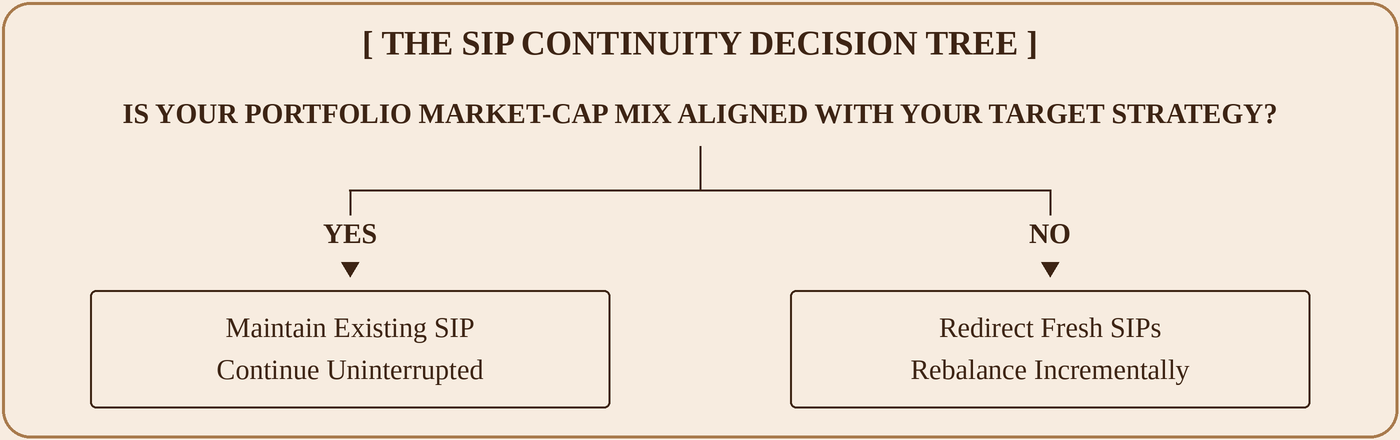
For investors whose current asset allocation remains well within their planned strategic parameters, systematic investment plans should continue uninterrupted.
A market correction does not alter the fundamental rationale for systematic compounding. Similarly, a period of strong performance in small or mid-caps should not automatically serve as a prompt to cancel fresh monthly contributions to those categories.
Intervention is required only when market movements have structurally altered the overall portfolio architecture:
- When Target Mix Is Intact: Continuing the existing SIP schedule maintains long-term execution discipline.
- When Portfolio Has Drifted: Adjusting incremental SIP directions provides a seamless rebalancing mechanism.
Redirecting Incremental SIP Flows: Rebalancing Without Selling
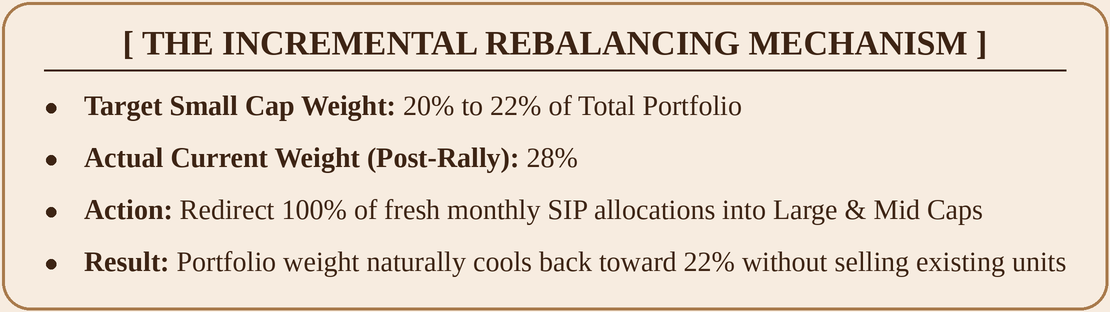
The impact of recent small cap outperformance is most pronounced for investors who have maintained continuous allocations to the category over multi-year horizons. With small caps having rallied around 25% in FY27 through August 2026, their relative weight within an un-rebalanced estate may have expanded beyond target boundaries.
Within an institutional allocation framework, a small cap weight of approximately 20% to 22% serves as a standard reference point.
If outperformance has pushed an investor's small cap exposure above this 22% ceiling, fresh monthly SIP cash flows can be redirected toward large and mid-cap schemes until aggregate portfolio weights realign with the strategic baseline.
This approach allows portfolio rebalancing to take place smoothly through fresh inflows rather than triggering capital gains taxes or exit loads by selling existing mutual fund units.
Rebalancing Must Restore Strategy, Not Chase Performance
The sole objective of portfolio rebalancing is to maintain planned risk parameters, not to chase whichever market segment appears most attractive at a single moment.
Consider two distinct investor scenarios operating in the exact same market environment:
Portfolio Rebalancing Application Scenarios
(Source: Anand Rathi Wealth Research)
The external market environment is identical for both investors. What differs is their internal portfolio allocation. That is why an investor's specific portfolio structure, rather than index movements in isolation, must dictate whether rebalancing is necessary.
Framework for a 5-to-10-Year Investment Horizon
For high-net-worth investors operating across a multi-decade horizon, short-term valuation gaps are far less important than maintaining a disciplined, long-term asset allocation.
Historical market data over 7-to-10-year rolling periods shows that diversified equity portfolios have delivered returns above 7% in almost all observed market cycles. This empirical reliability supports a higher equity allocation for long-term wealth accumulation.
Under this structured framework:
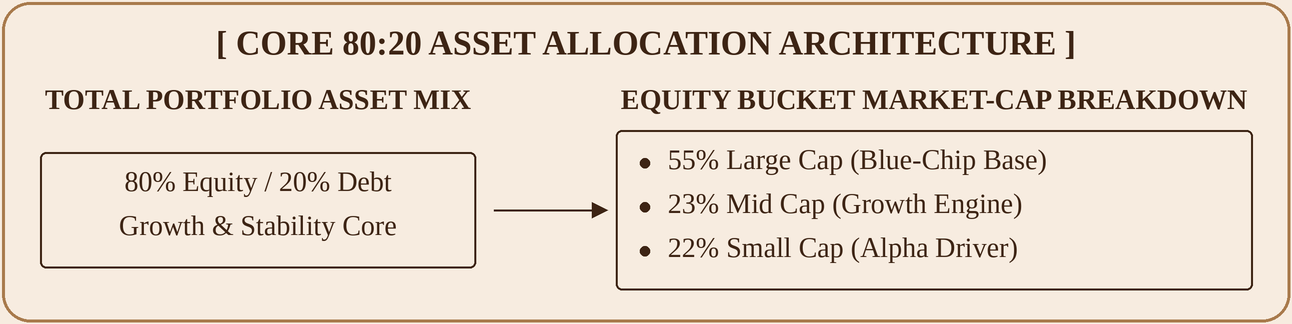
- Strategic Asset Mix: Equity can constitute up to 80% of total wealth, with the remaining 20% allocated to high-quality debt and liquidity reserves.
- Equity Market-Cap Distribution: Equity capital is distributed as 55% Large Cap, 23% Mid Cap, and 22% Small Cap. Large caps provide core stability, while mid and small caps drive mid-term expansion and alpha generation.
Corporate Earnings Growth Supports the Long-Term Outlook
Underlying corporate earnings delivery continues to provide a strong fundamental foundation for Indian equities. Nifty 50 corporate earnings are projected to expand by approximately 14% for FY27.
Against this backdrop of double-digit earnings growth, standard market pullbacks do not justify altering a multi-year strategy. For investors whose current asset allocation permits additional equity exposure, periods of market correction offer an opportunity to deploy surplus cash reserves into equities within pre-established portfolio boundaries.
Actionable Summary: The Uncomplicated Rebalancing Rule
A sharp run-up in mid and small caps can create portfolio imbalances, but it does not automatically require rewriting your long-term wealth strategy.
Wealth owners should follow three clear rules:
- Check Internal Weights First: Determine if small caps exceed 22% of your total equity portfolio.
- Continue SIPs if Aligned: If your asset mix remains within target ranges, maintain your existing SIP contributions without reacting to short-term noise.
- Rebalance via Incremental Cash Flows: If outperformance has created an overweight position, redirect fresh monthly SIPs toward large caps until strategic equilibrium is restored.
Expert Perspective
"A strong run in one segment of the market should not become the reason to rewrite a long-term investment strategy. What matters is whether that performance has changed the portfolio's intended allocation. For investors whose small and mid-cap exposure remains aligned with their strategy, continuing SIPs maintains investment discipline. Where outperformance has created an overweight position, fresh money can be redirected towards other market cap segments to restore balance."
Bharath Rathore, Executive Director & Unit Head, Bengaluru & Mangaluru | Anand Rathi Wealth Limited
Bharath Rathore
Executive Director & Unit Head, Bengaluru & Mangaluru
About Anand Rathi Wealth
This article is published by
Anand Rathi Wealth Limited (ARWL), an NSE500-listed wealth firm established in 2002. ARWL works with 14,309 client families across India and abroad, managing assets of ₹1,08,377+ crores across 19+ cities in India, alongside a dedicated international presence in Dubai and
the UK.ARWL operates as a CFO for personal wealth, bringing objective-driven portfolio construction, an uncomplicated process, and a long-term perspective that prioritises consistency of outcomes over short-term performance.
Our Approach to Investment Insights
At Anand Rathi Wealth, every insight is grounded in data, structured around a clear investment objective, and designed to be understood without jargon. The goal is not to impress, it is to inform. The insights in this article are designed to encourage evaluation of consistency over isolated returns, highlight the value of structured portfolio frameworks, and support informed decision-making.
This article has been reviewed for factual accuracy by Anand Rathi Wealth Limited's insight's function. This content is for informational and educational purposes only. It is designed to help readers make informed financial decisions. To understand how this content is created and reviewed, visit our
Content Standard Page.Disclaimer
This article is for informational and educational purposes only. The fund and scheme names used in this article are illustrative examples for explaining diversification and overlap. They should not be treated as investment action, product endorsement, or a promise of future performance.
FAQs
A strong rally alone is not a valid reason to halt a systematic investment plan. Review whether small caps still account for their intended share (around 20% to 22%) of your overall portfolio. If your allocation remains aligned with your wealth goals and risk capacity, recent market gains should not trigger a change.