Core and Satellite Portfolios: A Structured Framework for HNI Wealth Creation
April-2026
12:00 PM

The beginning of Financial Year 2026–27 (FY27) is not just a routine transition. For high-net-worth individuals, it is a moment that deserves far more attention than it typically receives. The way you approach financial year planning for HNIs at the start of FY27 can quietly shape outcomes for years ahead.
Most portfolios do not suffer because of one poor decision. They drift over time. Small deviations in allocation, unstructured additions and delayed reviews slowly reduce efficiency. This is why financial year planning for HNIs is less about making new decisions and more about restoring structure.
Based on market behaviour, investors who begin the year with clarity tend to experience better consistency, fewer reactive decisions and stronger alignment with their wealth goals. This aligns with our data-backed approach where discipline and process consistently outperform reactive behaviour.
FY27 begins in a market environment that is more balanced and less forgiving. Broad momentum is no longer sufficient. Earnings visibility, allocation discipline and risk control are playing a larger role in determining outcomes.
This is where financial year planning for HNIs becomes essential rather than optional. Our analysis shows three clear patterns:
In such conditions, financial year planning for HNIs helps reduce noise and bring clarity to decision-making.
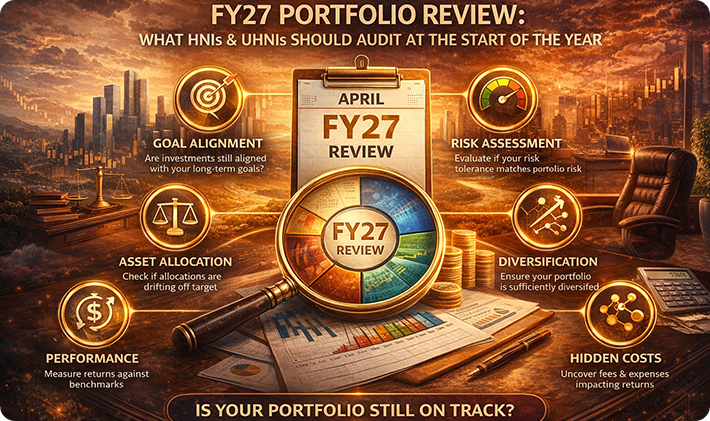
Over a year, portfolios evolve in ways that are not always visible. Market movements increase exposure in certain areas, while new investments may create overlap or inefficiency. A detailed portfolio review FY27 helps uncover:
Without this step, financial year planning for HNIs becomes incomplete.
A structured review is not about finding faults. It is about bringing clarity. Once clarity improves, decisions naturally become more objective-driven.
One of the most consistent insights from long-term data is that asset allocation plays a dominant role in wealth creation. Selection matters, but structure matters more.
A well-defined financial year reset strategy ensures:
For HNIs, this step is critical because capital preservation and growth must coexist. Financial year planning for HNIs ensures that this balance is maintained.
Many investors simplify this through a core and satellite portfolio approach, which separates stability from opportunistic exposure while maintaining clarity.
Tax decisions taken early in the year are more effective than those taken at the end. Once gains are realised or positions are locked, flexibility reduces.
This makes financial year planning for HNIs particularly important from a tax perspective. Early planning helps in:
This becomes even more relevant when you understand the difference between tax saving vs tax harvesting strategies,as both serve different roles within a structured approach.
A forward-looking FY27 investment strategy ensures that taxation does not quietly erode long-term returns.
Liquidity planning is rarely prioritised until it becomes urgent. For HNIs, this can create unnecessary pressure during market volatility.
A well-executed financial year planning for HNIs framework includes:
Liquidity is not just about access to funds. It is about maintaining flexibility and avoiding disruption to long-term strategy.
Markets are unpredictable. A structured process is what keeps outcomes stable. An effective HNI financial planning India approach focuses on:
Our objective-driven process is designed to remove emotion from investing. When decisions are guided by data rather than sentiment, outcomes tend to be more stable.
This is where financial year planning for HNIs becomes powerful. It transforms investing from reactive to structured.
Waiting for the “right time” often leads to missed opportunities for alignment.
Short-term trends should not dictate long-term decisions.
A portfolio without structure can lead to duplication, inefficiency and confusion. Avoiding these ensures that financial year planning for HNIs remains uncomplicated and effective.
When done correctly,financial planning for HNIs creates long-term advantages:
These are not immediate outcomes. They build gradually, but their impact is significant over time.
This aligns with our data-backed approach where clarity over noise leads to more consistent results.
The start of FY27 is an opportunity to reset, not just review.
A structured approach to financial planning for HNIs ensures that your portfolio reflects your objectives, not market noise. It creates a foundation where decisions are guided by data, aligned with goals and executed with discipline.
We believe wealth creation should be uncomplicated. When structure replaces assumption and clarity replaces complexity, long-term outcomes naturally improve.