Core and Satellite Portfolios: A Structured Framework for HNI Wealth Creation
April-2026
12:00 PM
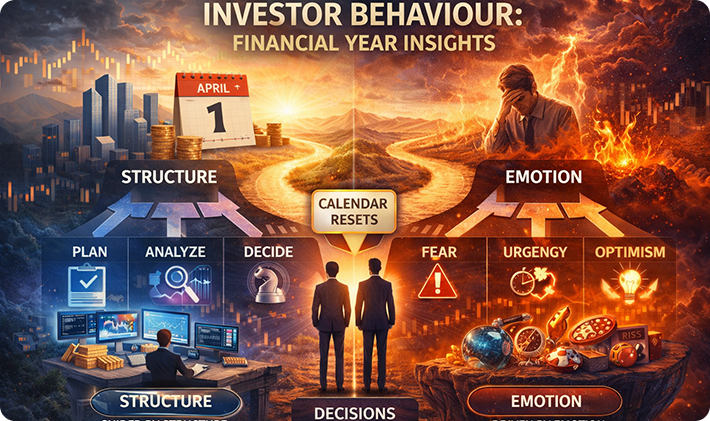
The start of a new financial year often feels like a clean slate. For most investors, it is time to set fresh goals or think about new opportunities. For high-net-worth individuals and ultra-high-net-worth individuals, however, it is something more important. It is the right moment to pause and evaluate what already exists.
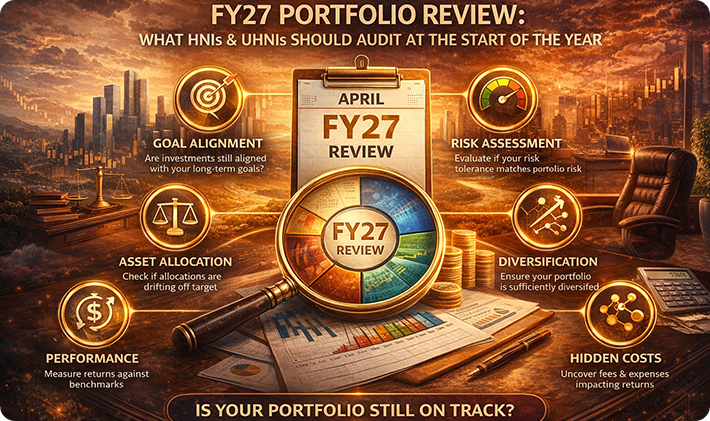
A FY27 portfolio review for HNIs and UHNIs is not about reacting to markets. It is about understanding whether your current portfolio still reflects your long-term wealth goals. Over time, even well-built portfolios can drift. Allocations shift, risks change quietly, and decisions made in different phases begin to overlap.
A structured review helps bring everything back into alignment.
Most portfolios do not become inefficient overnight. The shift is gradual.
Over the past year, markets have moved through different phases. Some assets may have grown faster than others. Certain exposures may have increased without intent. In some cases, decisions taken for short-term reasons may still be sitting in the portfolio.
A portfolio review at the start of FY27 allows HNIs and UHNIs to:
This is less about making changes and more about understanding what needs to be retained, adjusted or removed.
The first step in any FY27 portfolio review for HNIs and UHNIs is to step back and look at the full picture.
A well-constructed portfolio typically consists of multiple asset classes, each serving a specific purpose. These may include:
| Asset Class | What It Includes | Purpose in Portfolio |
|---|---|---|
| Equity | Equity Mutual Funds, Direct Stocks | Long-term growth and wealth creation |
| Debt / Fixed Income | Bonds, debt mutual funds, fixed income products | Stability, predictable income and capital protection |
| Real Estate | Real estate, private markets, structured investments | Diversification and non-correlated returns |
| Commodities | Gold, Silver, Copper | Diversification & Hedging purpose |
Over time, the balance across these asset classes changes, which is why periodic review becomes essential.
For example, strong equity performance may increase overall exposure to risk assets, while liquidity allocation may reduce without intention.
Ask yourself:
This is not about reacting to recent performance. It is about ensuring that your allocation continues to reflect your long-term objectives and risk appetite.
One of the most common outcomes of long-term investing is accumulation.
Portfolios often end up holding multiple investments that serve similar purposes. This creates the illusion of diversification but does not necessarily improve outcomes.
During a FY27 portfolio review for HNIs and UHNIs, look for:
Simplifying the structure often improves clarity and control.
Returns are visible. Risk is not always obvious.
A portfolio may appear stable during favourable market conditions but behave very differently during corrections. This is why a FY27 portfolio review for HNIs and UHNIs must include risk evaluation.
Focus on:
Understanding risk helps you prepare for uncertainty rather than react to it.
Tax impact is often underestimated.
Many portfolios generate reasonable returns but lose efficiency due to poor tax structuring. A FY27 portfolio review for HNIs and UHNIs should include:
This is where concepts such as tax saving vs tax harvesting strategies become relevant. Instead of focusing only on deductions, the goal should be to improve overall tax efficiency within the portfolio.
Liquidity is often overlooked until it is needed.
A well-constructed portfolio ensures that liquidity is available without disrupting long-term investments. During your FY27 portfolio review for HNIs and UHNIs, consider:
Liquidity should support your life decisions, not restrict them.
Over time, portfolios can become a mix of ideas rather than a structured approach.
A FY27 portfolio review for HNIs and UHNIs should bring everything back to one clear strategy.
This includes:
This is also where a core and satellite portfolio approach becomes useful. It separates stability from flexibility, allowing you to manage both with clarity.
Markets influence behaviour more than most investors realise.
Think about the past year:
A FY27 portfolio review for HNIs and UHNIs is not just about numbers. It is also about understanding behaviour and improving decision-making going forward.
Across portfolios, certain patterns tend to repeat:
Recognising these gaps early helps avoid larger corrections later.
A detailed FY27 portfolio review for HNIs and UHNIs should ideally be done at the start of the financial year.
Beyond that:
The key is consistency, not frequency.
A portfolio does not need constant changes. It needs periodic clarity.
A well-executed FY27 portfolio review for HNIs and UHNIs helps you:
When your portfolio is structured, decisions become simpler.
When decisions are simpler, outcomes become more consistent.
That is how wealth remains uncomplicated.