How Can HNIs Plan Liquidity for Large Portfolios Without Compromising Growth?

Summary
In a large portfolio, the bigger risk is rarely a poor investment choice. It is being forced to sell long-term equity to meet a cash need at the wrong moment.
Liquidity planning prevents this by holding a dedicated short-term bucket, so near-term needs are funded from stable assets while the equity bucket is left to compound undisturbed.
In a large portfolio, the bigger risk is rarely a poor investment choice. It is being forced to sell long-term equity to meet a cash need at the wrong moment.
Liquidity planning prevents this by holding a dedicated short-term bucket, so near-term needs are funded from stable assets while the equity bucket is left to compound undisturbed.
For investors with substantial portfolios, the instinct is often to focus entirely on growth: which assets will compound fastest, which opportunities deserve more capital,
how to make every rupee work harder. Growth matters. But there is a quieter discipline that determines whether that growth ever reaches you, and it is liquidity. Access to capital,
representing the ability to meet a need without disturbing your long-term investments, is not a secondary concern. In a large portfolio, it is as important as the return itself.
Liquidity planning is the practice of structuring a portfolio so that cash needs can be met without disturbing long-term investments. It sets aside a dedicated short-term reserve,
typically in debt and other stable, accessible instruments, to fund planned expenses and emergencies, ensuring that growth assets such as equity are never sold under pressure.
The Core Strategy: Start With Two Buckets
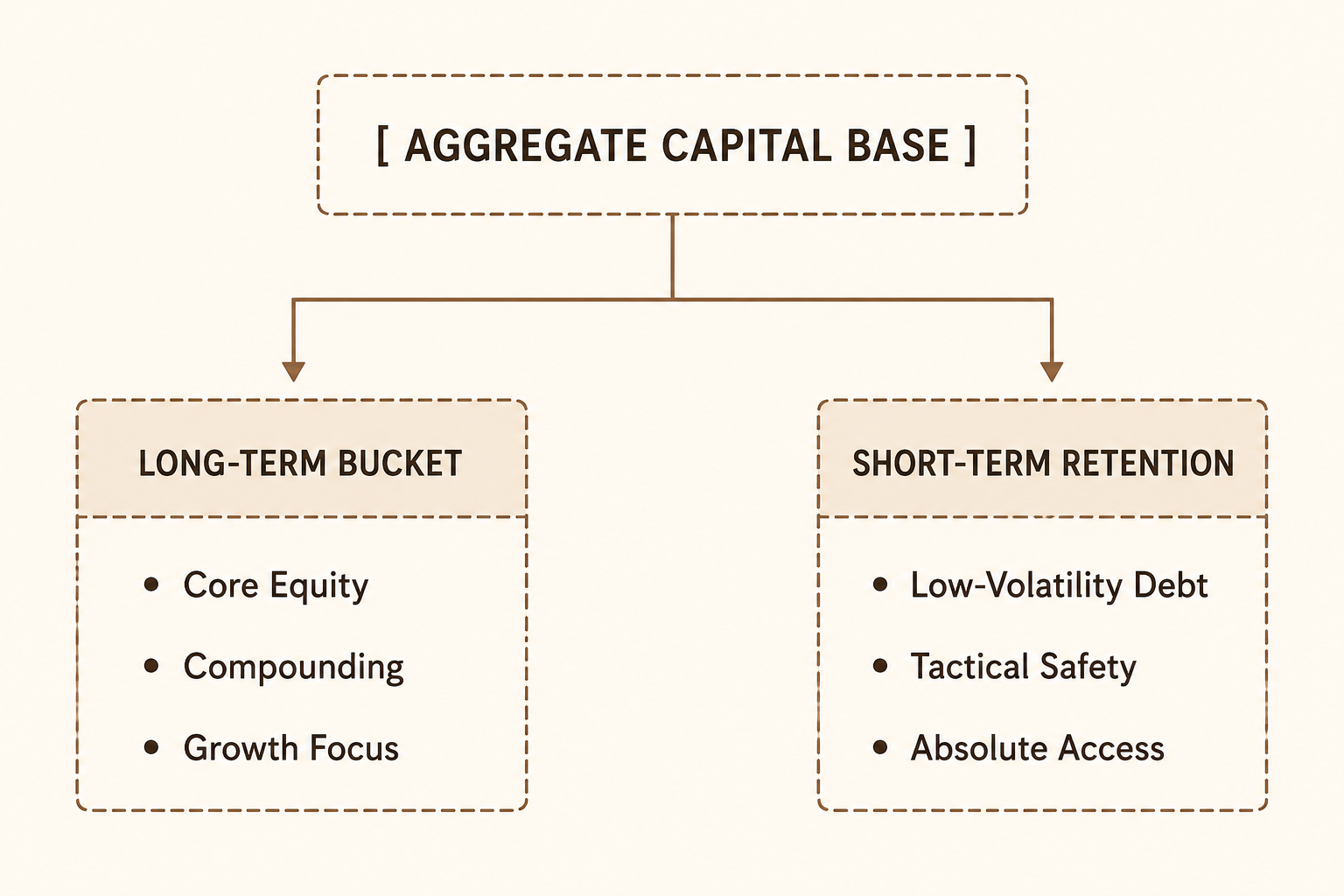
Every well-structured portfolio rests on a clear asset allocation. At its simplest, this means dividing capital into two buckets, each with a distinct job.
Long-Term Bucket
The long-term bucket holds equity investments. Its purpose is
wealth creation through compounding over years and decades,
allowing investments to ride through market cycles.
Short-Term Retention Bucket
The short-term bucket contains debt and other stable assets. It
provides liquidity for planned expenses and emergencies, so
long-term investments remain untouched.
The long-term bucket holds equity. Its purpose is growth. This is the capital meant to compound over years and decades, riding through market cycles to build real wealth.
The short-term bucket holds debt and other stable, accessible instruments. Its purpose is not growth. It is stability and access. This is the capital you can reach for when life requires it.
These buckets are not competing for your attention. They are doing different jobs, and a portfolio works best when each is allowed to do its own.
Why the Split Actually Matters for Capital Preservation
Here is the part that is easy to overlook. Equity compounds, but only if it is left alone. Consider a simple illustration. Take a portfolio structured as 80 % long-term equity
and 20 % short-term debt. The equity is meant to grow over years. The debt is there for stability and access.
It also helps to remember how often markets test that structure. Looking at two decades of Nifty 50 history, a 10 % correction has arrived roughly once a year, and a 20 % fall
about once every four years. A large portfolio held across decades will meet many of these. The question is never whether a downturn will coincide with a cash need, only when.
Now suppose a significant cash need arises, and it arises during one of these downturns, which is often exactly when financial pressures appear. The investor with a short-term bucket
simply draws on that 20%. The 80% in equity is never touched. It stays invested, and it remains in place to participate when the market recovers.
Compare that with an investor who holds everything in equity. The same cash need now forces a sale, and because it falls during a downturn, the sale happens at depressed prices.
A temporary fall is converted into a permanent loss, and the capital that was sold is no longer there to recover when the market turns.
The damage is larger than it first appears, because losses and gains are not symmetric. A loss needs a disproportionately bigger gain just to get back to where it started.
MATHEMATICAL SYMMETRY
THE ASYMMETRY OF PORTFOLIO RECOVERY
Source: Anand Rathi Wealth Research.
Recovery percentages are arithmetic: a 30% fall leaves
70% of capital, which must rise by about 43% to return
to the original value.
Selling into a 30% decline does not cost you 30%. It costs you the 43% recovery that the remaining capital would have earned had it stayed invested. That is how a paper loss becomes a permanent one.
Evaluating the Timeline of Market Recoveries
Recovery is not always quick. Historically, the median recovery from a 10% plus Nifty drawdown has taken roughly five months from the bottom, but deeper episodes have run far longer.
The 2008 correction took close to five to six years to reclaim its previous peak, while the sharp 2020 fall recovered in under a year. An investor without a buffer who needs cash during
a long recovery has no choice but to keep selling into the hole.
This is why the short-term bucket exists. It is not idle money sitting on the sidelines. It is the buffer that ensures a cash need never forces an equity sale at the wrong moment.
Access and growth are not opposing goals. Access is what allows growth to continue, uninterrupted, through every cycle.
And there is good reason to let the long-term bucket run. Over the same history, the Nifty 50 has spent close to two-thirds of its days within 10% of an all-time high, and the chance of
a negative return over any five-year holding period has been close to 1%. Being near highs is the normal state of a rising market, and time has reliably rewarded those who stayed invested.
The job of the short-term bucket is to make sure you can afford to wait.
In a large portfolio, this protection is even more valuable because the sums involved are larger and the cost of a poorly timed exit is greater. For an explicit look at how these equity segments compound
over extended horizons when properly insulated, see our analysis on portfolio construction for HNIs and building a foundation for long-term wealth.
Fixed Income Category Baselines
- Short Duration Fund Class: 1-Year trailing returns average 3.78%, expanding to a 6.49% annualized 3-Year CAGR baseline.
- Liquid Fund Class: 1-Year trailing returns average 4.92%, with a 5.74% annualized 3-Year CAGR baseline.
(Source: Historical category performance metrics processed from utilizing evaluation engines verified against ACE MF datasets. Past yields serve strictly as an empirical reference point and do not represent a predictive promise.)
The modest difference between that and the long-term equity return is the small, deliberate price of never being a forced seller. Set against the cost of one badly timed equity sale,
it is among the cheapest protection a large portfolio can hold. In a large portfolio, this buffer may be a modest share of the total in percentage terms while still being a substantial
amount in absolute rupees. That is exactly as it should be; the buffer is sized to your life, not to a fixed ratio. To see how this allocation maps into a diversified multi-cap asset
framework, review our guide on
portfolio realignment and managing concentration risk..
Conclusion: The Balance That Holds Wealth Together
Good liquidity planning is not about choosing between safety and growth. It is about structuring both so they support each other. The objective is to create a balance where
near-term needs are accounted for, while long-term wealth creation continues with discipline.
When the short-term bucket is doing its job, you gain something that is hard to measure but easy to feel: the freedom to stay invested, calmly, through whatever the market does next.
That is what access to capital really buys: not just liquidity, but the confidence to let your wealth compound undisturbed.
About Anand Rathi Wealth
This article is published by Anand Rathi Wealth Limited (ARWL), an NSE500-listed wealth firm established in 2002. ARWL works with 13,941 client families across India and abroad,
managing assets of ₹1,06,300 crores across 18+ cities in India, alongside a dedicated international presence in Dubai and the UK.
ARWL operates as a CFO for personal wealth bringing objective-driven portfolio construction, an uncomplicated process, and a long-term perspective that prioritises consistency of
outcomes over short-term performance.
Our Approach to Investment Insights
At Anand Rathi Wealth, every insight is grounded in data, structured around a clear investment objective, and designed to be understood without jargon. The goal is not to
impress it is to inform.
The insights in this article are designed to encourage evaluation of consistency over isolated returns, highlight the value of structured portfolio frameworks,
and support informed decision-making.
This article has been reviewed for factual accuracy by Anand Rathi Wealth Limited’s insight's function. This content is for informational and educational purposes only.
It is designed to help readers make informed financial decisions.
To understand how this content is created and reviewed, visit our Content Standard Page
Disclaimer
This article is for informational and educational purposes only. The fund and scheme names used in this article are illustrative examples for explaining diversification and overlap. They should not be treated as investment action, product endorsement, or a promise of future performance.
FAQs
Liquidity planning is the process of structuring a portfolio so that planned expenses, emergencies, or major cash needs can be met without disturbing long-term investments.
It helps investors maintain a dedicated short-term reserve while allowing the long-term equity portion of the portfolio to continue compounding undisturbed.
For high-net-worth investors, the cost of selling long-term investments at the wrong time can be significant. Liquidity planning helps ensure that near-term needs are funded
from stable and accessible assets, reducing the risk of forced equity sales during sudden market corrections.
A short-term bucket holds debt and other stable, accessible instruments that can be used for planned expenses or emergencies. This protects the long-term equity
bucket from being sold during market downturns, allowing it to remain fully invested through recovery periods.
The right liquidity amount depends on the investor’s expenses, commitments, near-term goals, and emergency needs. The focus should be on maintaining enough accessible
capital to avoid selling equity during a downturn, especially if a full market recovery takes longer than expected.
No, liquidity does not mean money must remain idle. The short-term bucket can be held in suitable debt and stable instruments that provide access, lower volatility,
and the potential to earn modest returns while preserving maximum financial flexibility.
Without liquidity planning, an investor may be forced to sell equity during a market correction to meet an unexpected cash need. This turns a temporary market decline
into a permanent loss and reduces the capital available to participate in the eventual market recovery.